
Is it time to make the switch to a Digital planner?
If you’ve ever stood in the stationery aisle, mesmerized by the smell of fresh paper and the promise of a new beginning, you aren’t alone. There is a specific kind of magic in clutching a pretty paper planner. But if you also love the idea of having your entire life organized on your iPad with just a tap, you’ve likely wondered: Is it time to make the switch to a digital planner?
The planning community is often divided between “paper purists” and “digital devotees.” While both have their merits, the shift toward a more flexible, tech-forward lifestyle is making the digital journal and planner more popular than ever. Let’s break down the pros and cons to help you decide which tool will actually help you get things done.
The Timeless appeal of paper planners
For many, the “analog” experience is a form of self-care. It’s a break from screens and a way to disconnect.
The Pros:
- Tactile Satisfaction: There is a neurological connection between handwriting and memory retention. Writing things down can help you process information more deeply.
- Zero Battery Anxiety: A paper planner never dies. It doesn’t need a Wi-Fi connection or a charging cable—just a pen and a quiet moment.
- Creative Freedom: For those who love “junk journaling” or scrapbooking, paper offers a physical space for stickers, washi tape, and hand-drawn doodles.
The Cons:
The Bulk Factor: Carrying a thick, A5 hardcover planner in your bag every day can become a literal weight on your shoulders.
Zero Room for Error: Once you write in ink, it’s there to stay. White-out can only do so much, and there is no “undo” button for a ruined layout.
Static Layouts: You are stuck with the number of pages the manufacturer gave you. You can’t easily add a new section for a sudden project.
Why Digital Planner is winning the Future
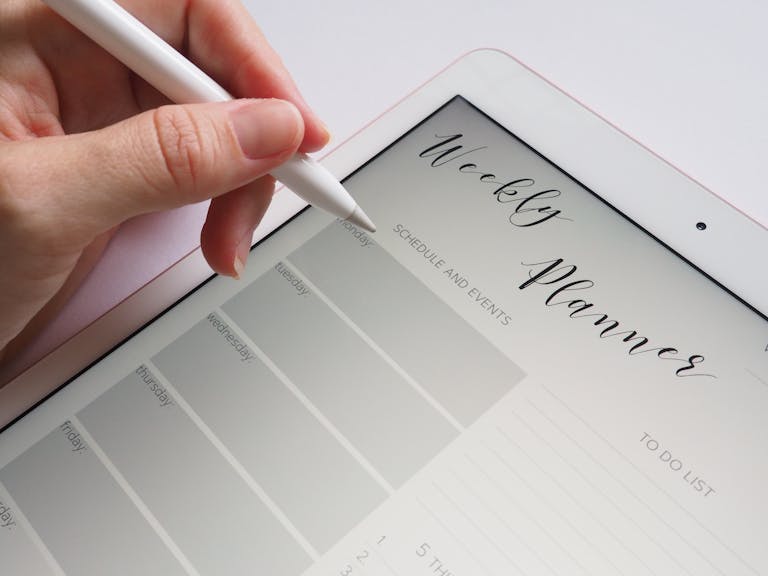
f you want your organization system to be as dynamic as your life, a digital planner is a game-changer. By using an iPad or tablet along with a stylus, you get the “handwritten” feel without any of the analog limitations.
The Pros:
- Infinite Customization: Want to duplicate a habit tracker? Need ten extra notes pages for a brainstorming session? With a digital planner, you can add, delete, and move pages without ever ruining the binding.
- Hyperlinked Efficiency: High-quality planners (like those we design at Rakshi Creations) are fully hyperlinked. This means you can jump from your “Yearly Overview” to a specific “Daily Spread” in one click. No more flipping through hundreds of pages to find your notes.
- Portability & Syncing: Your entire life fits inside your tablet. Plus, if you use apps like GoodNotes, Notability, or Xodo, you can often sync your planner to your phone, ensuring your schedule is always in your pocket.
- The All-in-One Digital Journal: Many users find that a digital journal allows them to combine their schedule, their gratitude practice, and their photo memories in one place. You can drag and drop photos directly from your camera roll into your daily spread!
The Cons:
Device Dependency: You do need a tablet and a stylus (like an Apple Pencil) to get the full experience.
Initial Setup: There is a small learning curve when you first import your PDF into an app.
So… Which One’s Right for You?
If you love the feel of pen on paper, don’t mind carrying a notebook, and enjoy the analog vibe—paper planning might be your thing.
But if you’re looking for something more flexible, fun, customizable, and clutter-free—then a digital planner is the way to go. It’s perfect for busy entrepreneurs, moms, students, or anyone who wants to stay organized without the bulk.
Final Thoughts
There’s no one-size-fits-all, and the best planner is the one you’ll actually use. But if you’ve never tried digital planning, now might be the perfect time. At Rakshi Creations, We design aesthetically design, functional, and fully hyperlinked digital planners that bring beauty and simplicity to your daily routine. 💗
➡️ Ready to go digital? Browse our digital planner collection and check what is right for you.